
The Responsible One
Beyond Endurance to Balance

Every family, friend group, and workplace seems to have that one person who carries more than everyone realizes. The reliable one. The calm one. The one who remembers birthdays, pays bills on time, replies to urgent messages, and somehow keeps functioning even when exhausted.
The Responsible One.
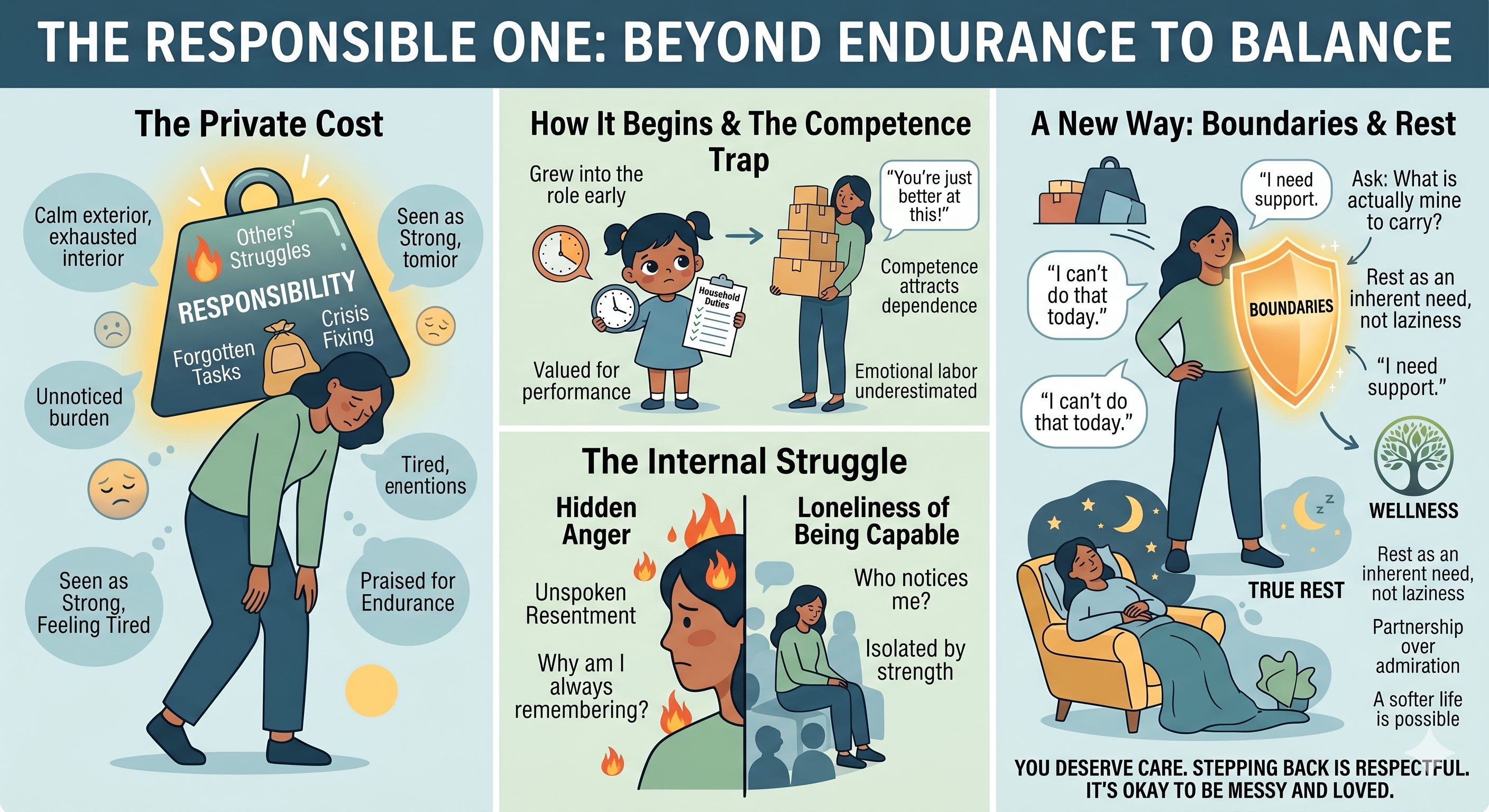
From the outside, you look admirable. You are organized, mature, and dependable. People praise you for having it together. But there is a private cost to becoming the person everyone leans on. Because responsibility, when carried too long and too quietly, becomes a burden no one else even notices.
How It Begins: The Yoga of “Yes”
Many responsible people did not choose this role so much as grow into it early. Maybe you were the child who learned to stay quiet because the house already had enough chaos. You managed emotions and anticipated conflict, becoming easy so others could survive.
Compliments can become cages when identity forms around usefulness. You learn a subtle but powerful lie: I am valued when I perform. I matter when I carry weight. So, you keep carrying.
The Competence Trap
Because you can handle things, you are given more things. People say, “You are just better at this stuff”. What they often mean is that they have become comfortable letting you do it.
There is a deep loneliness in being seen as strong all the time. When people assume you are okay, they stop asking deeper questions. You become a container for everyone else’s needs, the listener, the advisor, the fixer. Yet you are left wondering who checks on the person everyone else depends on.
The Hidden Anger and the “Second Dart”
Beneath that capable exterior, there is often resentment. Why are you always the one remembering the details? Why do others get to be careless?
In mindfulness, we talk about the two dart theory. The first dart is the situation, which is the load you carry. The second dart is your reaction to it, such as the guilt or the feeling that you should not feel this way. Unspoken burdens do not disappear; they leak out as sarcasm or emotional numbness.
What Rest Feels Like
Interestingly, for the responsible person, rest does not feel restful at first. When you slow down, the anxiety rises. You worry you are failing or that others will be disappointed. Stillness feels like a threat when your nervous system is used to earning safety through action.
You stay busy not because you love it, but because movement feels safer than being alone with your own needs.
Learning a New Way: Boundaries Are Not Betrayal
The burden softens through balance, not by becoming irresponsible. It starts by asking difficult questions:
What is actually mine to carry?
Who am I when I am not being useful?
Setting a limit, such as saying “I can not do that today” or “I need help too,” is not cruelty. It is clarity. Healthy people adjust to boundaries. Only those benefiting from your over-functioning will call them unfair.
The Bottom Line
You deserve more than praise for your endurance. You deserve real reciprocity and a soft life where you do not have to earn your right to exist.
The most important thing to remember: The Responsible One desperately needs a mechanism to set boundaries and truly rest. You are allowed to be more than just useful. You are allowed to need help before you collapse.
You do not have to carry every room you enter just because you learned how.
What about you? Are you the fixer in your group? How do you carve out space to just be without feeling like the world will stop spinning? Drop a comment below. I would love to hear how you are learning to put the boat down.
Thanks for reading! If this resonated, feel free to share it with the Responsible One in your life, even if that is you